
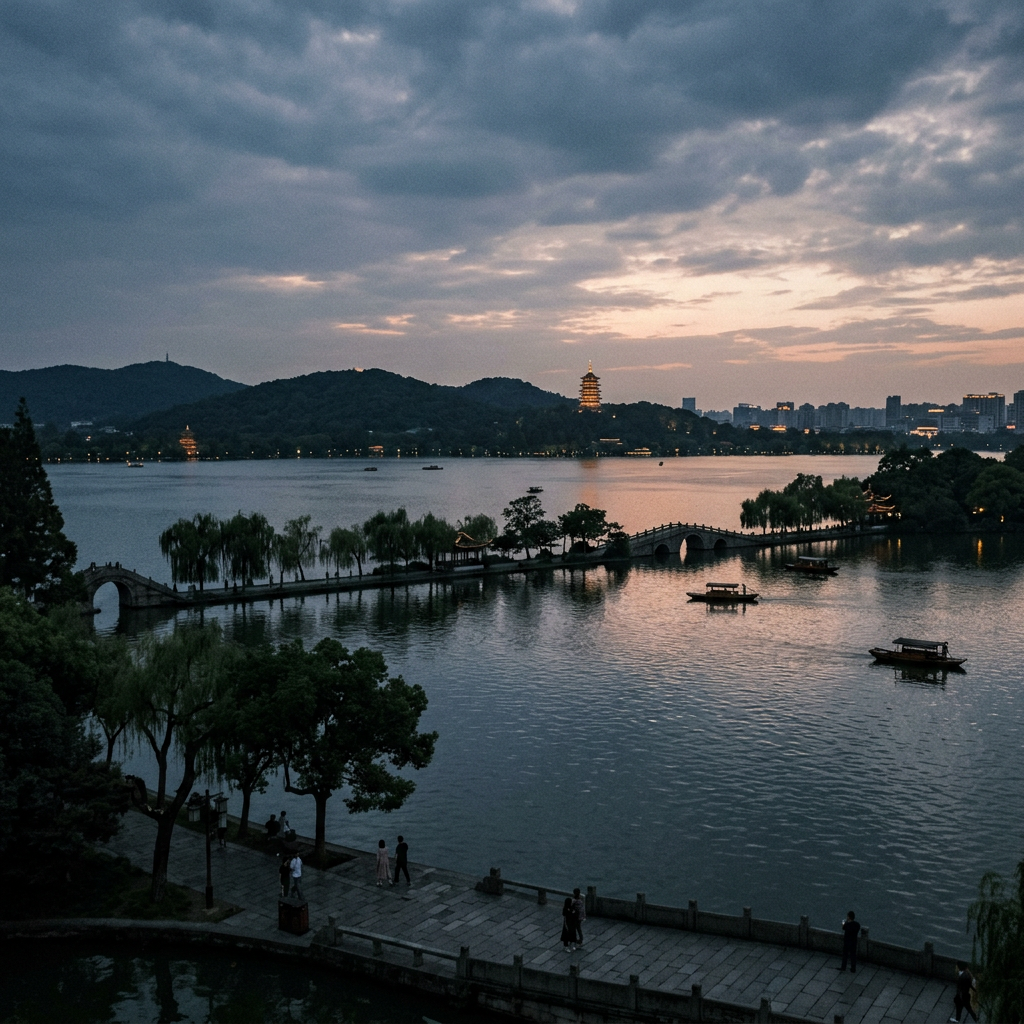
A complete Hangzhou travel guide — West Lake walking routes, the Longjing tea village, what to eat, and how to plan a 1-2 day trip from Shanghai.
West Lake has been inspiring poets, painters, and emperors for roughly a thousand years, and it’s still the reason most people come to Hangzhou. What makes the city more than a pretty lake is what surrounds it: the tea hills of Longjing village just to the west, centuries-old temples tucked into the surrounding mountains, and an easy, walkable pace that makes it one of the most relaxing add-ons to a Shanghai trip. This guide covers West Lake, the tea village, what to eat, and how to time a 1-2 day visit.
Why Hangzhou Is an Easy, Worthwhile Add-On
Hangzhou sits less than an hour from Shanghai by high-speed train, which makes it one of the simplest and most rewarding day trips — or short overnight stays — in the entire Jiangnan region. The city’s defining landscape, West Lake, is so closely tied to Chinese poetry and painting that the West Lake Cultural Landscape carries UNESCO recognition, with the surrounding Longjing tea gardens explicitly included as part of that designation.
What to Eat and Drink in Hangzhou
– Longjing shrimp — one of Hangzhou’s signature dishes, pairing the region’s famous green tea with fresh river shrimp.
– Dongpo pork — a slow-braised pork belly dish named for the Song-dynasty poet Su Dongpo, who reportedly invented it.
– West Lake vinegar fish — a sweet-and-sour fish dish that’s been a local specialty for centuries.
– Longjing tea — genuine Longjing comes from a small, specific zone west of West Lake; the first-flush harvest in early April (called tóuyá) produces small, intensely aromatic leaves and is considered the most prized tea in China. A lakeside tea house pairing Longjing with a Dingsheng cake is the classic Hangzhou afternoon.
A small cultural note: when someone pours tea for you in Hangzhou, it’s traditional to tap three fingers on the table — a simplified, centuries-old gesture of thanks.
Where to Base Yourself
– Near West Lake — the obvious choice for views and walkability, putting you steps from the lake’s circuit paths and several of the city’s best-known sights.
– City center — a more balanced option if you want easy access to both the lake and the city’s transit and dining options.
– Near Hangzhou East Station — only worth it if you’re catching trains early or late and want to minimize transit time; it’s not within walking distance of the lake.
The Essential Sights
West Lake. The centerpiece of any visit. A full loop walk takes a few hours and passes the Su Causeway, the Broken Bridge, and several small islands and pavilions that have anchored Chinese landscape painting for centuries. Most first-time visitors do a single walking loop rather than trying to see every corner — that’s enough.
Longjing Tea Village. A half-day trip into the hills just west of the lake, where you can walk through working tea plantations, watch the pan-roasting process, and buy tea directly from farmers. Spring (around the Qingming festival in early April) is harvest season and the most atmospheric time to visit, though autumn picking offers a different, quieter experience.
Lingyin Temple. One of China’s most significant Buddhist temples, set against a wooded hillside outside the city center — worth booking ahead if visiting around major holidays, when locals come to ring bells and light incense for blessings.
Hefang Street. A historic pedestrian street lined with traditional shops, teahouses, and restaurants — a good stop for a slower afternoon and local snacks.
Xixi National Wetland Park. A large wetland park with waterways and gardens, offering a quieter, more natural counterpoint to the lake’s more visited shoreline.
Suggested Itinerary
One day (as a Shanghai day trip): A tight West Lake walking loop in the morning, lunch near Hefang Street, and either Lingyin Temple or the Longjing Tea Village in the afternoon, depending on whether you prefer temples or tea.
Two days: Day one for the full West Lake loop and Hefang Street; day two for a half-day at the Longjing Tea Village followed by Lingyin Temple or Xixi Wetland Park.
Getting There and Around
High-speed trains connect Shanghai to Hangzhou in under an hour, making this one of the easiest rail day trips in the region. Within the city, the metro reaches most major areas, though West Lake itself is best explored on foot or by rental bike once you arrive.
Best Time to Visit
Spring (March–April) brings cherry blossoms along the Su Causeway and the Longjing tea harvest, making it the most popular — and most crowded — season. Summer is warm and humid, with lotus flowers blooming at Quyuan Fenghe Garden. Autumn offers a second tea-picking season and red leaves over the lake from nearby Baoshi Mountain. Winter is quiet and occasionally snowy, and a light snow over the Broken Bridge is considered one of the city’s most picturesque sights, however rare.
Combining Hangzhou with Shanghai, Suzhou, or the Jiangnan water towns? Get in touch and we’ll help you sequence the trip.
Leave a Reply