
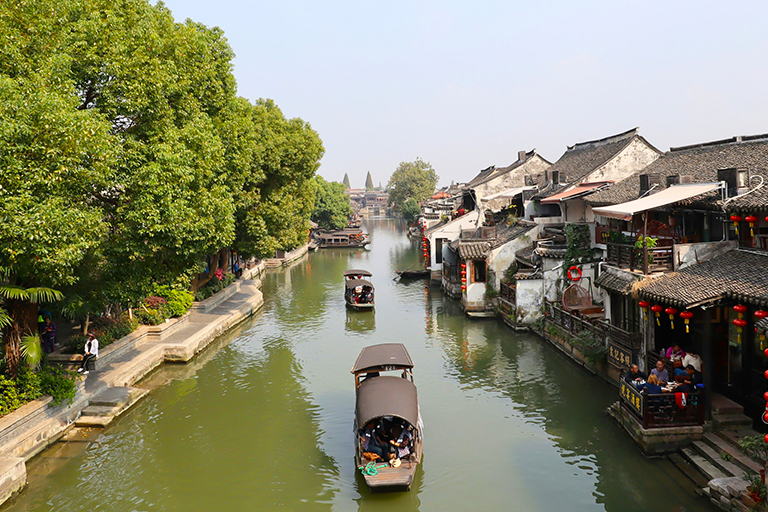
A complete Xitang travel guide — the Mist Rain Corridor, Shipi Lane, stone bridges, and how to plan a day trip from Shanghai, Hangzhou, or Suzhou.
Xitang has a distinctive feature none of the other Jiangnan water towns can quite match: over a kilometer of covered, tile-roofed walkways running directly along its canals, built originally to shelter residents from sun and the region’s signature drizzle. It also picked up a dose of pop-culture fame as a filming location for Mission: Impossible III. This guide covers the corridors, the bridges, and how to plan a day trip.
What Makes Xitang Different From Wuzhen or Zhouzhuang
Xitang holds UNESCO World Cultural Heritage recognition and carries the honorary titles “The Most Charming Film and Television Base in Water Town” and one of “China’s Top Ten Ancient Towns.” But locals and frequent visitors describe its real appeal differently: compared to the more polished, fully tourist-oriented presentation of Wuzhen, Xitang has a looser, more lived-in, everyday water-town feel — smaller lanes, a more casual rhythm, and a sense of being a genuine community first and a tourist attraction second. If Wuzhen is the complete, polished version of a Jiangnan water town, Xitang is the lighter, more textured alternative.
The Covered Corridors (Langpeng)
This is Xitang’s signature architectural feature: a tile-roofed footpath stretching over a kilometer (some sources cite up to 1,300 meters) along the waterside, providing shelter from sun and rain while showcasing intricately carved decorative details. Long benches are placed along the water side of the corridor specifically for resting — a built-in invitation to slow down rather than just walk through.
Shipi Lane
The narrowest and most famous of Xitang’s 122 named stone-paved lanes, Shipi Lane runs 68 meters long, narrowing to just 80 centimeters at its tightest point — wide enough for only one person to pass at a time. It’s one of the most photographed single spots in town, precisely because of how dramatically narrow and atmospheric it feels.
Songzi Laifeng Bridge
A gracefully arched Ming-dynasty stone bridge with carved railings featuring motifs of prosperity, harmony, and good fortune. Its name, meaning “Bringing Phoenix and Offspring,” reflects traditional beliefs around fertility and family continuity, and it has long been considered a blessing point for newlyweds. Sunset is the recommended time to visit, when the bridge’s reflection forms a complete circle in the water below.
What to Eat
– Braised Baisi Fish — a signature local dish.
– Xitang Eight Bowls — a traditional banquet-style meal featuring eight different dishes, a good way to sample a range of local flavors in one sitting.
– Steamed pork wrapped in lotus leaves — sold near Songzi Laifeng Bridge, a popular snack while walking.
– River shrimp and yellow rice wine — both regional staples worth trying at a riverside restaurant.
– Zongzi (sticky rice dumplings) and soybean milk — a good traditional breakfast at a local teahouse before the day’s sightseeing begins.
Suggested One-Day Itinerary
Morning (8:00-12:00): Breakfast at a local teahouse, then wander the covered corridors while the town is still relatively quiet. Visit the West Garden, a peaceful classical garden with historic relics, and walk through Shipi Lane.
Afternoon (12:00-17:00): Lunch at a riverside restaurant, followed by a boat ride along the canals — one of the most consistently recommended ways to experience the town from the water rather than only on foot.
Evening (if staying later or overnight): Stay through sunset at Songzi Laifeng Bridge, then experience Xitang’s lantern-lit night scenery along the canals — widely considered one of the town’s most romantic and memorable sights, and a good reason to avoid treating this purely as a rushed day trip if your schedule allows otherwise.
Getting There
Xitang sits in Jiashan County, Zhejiang Province — roughly 85 km from Suzhou, 90 km from Shanghai, and 110 km from Hangzhou, making it a workable day trip from any of the three. The most common route from any of these cities is a high-speed train to Jiashan South Railway Station, followed by a tourist bus or local bus (K222) to the scenic area; alternatively, direct buses run from each city’s long-distance bus station to Xitang Bus Station, about a 10-minute walk from the scenic entrance. Opening hours run roughly 8:00am-5:30pm in summer and 8:00am-5:00pm in winter.
A Practical Note on Choosing Between Water Towns
If you’re trying to decide between Xitang and a nearby alternative like Wuzhen on a single Jiangnan-region trip, the general guidance holds up well: choose Wuzhen if you want the fullest, most polished single water-town experience, and choose Xitang if you want something a bit lighter, more lived-in, and less staged. Many travelers treat Xitang as the natural substitute for Wuzhen rather than a mandatory second stop — pick based on the texture you want, not just by name recognition.
Planning Xitang alongside Shanghai, Suzhou, or Hangzhou? Get in touch and we’ll help you sequence the water-town portion of your trip.
Leave a Reply